The NiNTh NaTioNal Service USer coNfereNce
8 |
drinkanddrugsnews
| March 2016
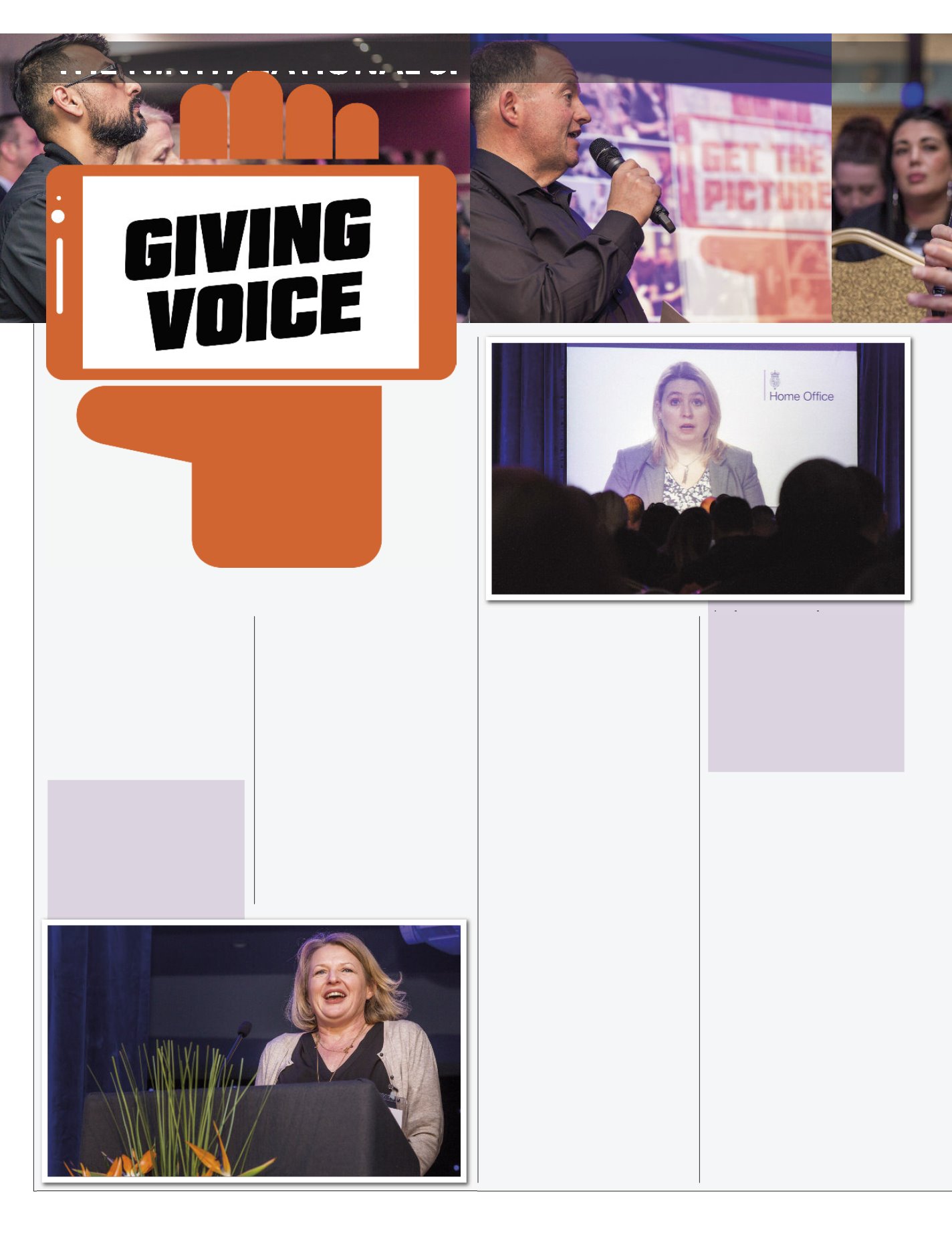
‘T
he new drug strategy is one
of my key priorities,’ minister
for preventing abuse,
exploitation and crime, Karen
Bradley, told delegates via video, and
the government was looking for
meaningful input to make sure it was
implemented effectively.
‘The government recognises that
drug use is a complex, evolving issue,’
she said. While it was ‘dedicated to
ensuring that fewer people use drugs in
the first place,’ the support was also in
place for those who did, she said, with
action needed at local, international and
individual level. ‘We need more targeted
action for the most vulnerable’, as there
were strong links between substance
misuse and other vulnerabilities.
This meant that effective
partnership working was essential, and
recovery-orientated systems of care
needed to be far broader than ‘just
treatment’ alone. ‘I do not
underestimate your vital role in peer
support and motivating others in their
recovery,’ she told the audience.
Delegates then heard from Karen
Biggs, chair of the Collective Voice
umbrella group of some of the sector’s
largest providers. Its aim was to ensure
that the sector had a voice, she said,
with the group already having input into
Professor Dame Carol Black’s benefits
review and the new drug strategy.
The sector as a whole had made very
good progress in understanding how
the service user voice could have an
impact, she stated. ‘How do we develop
a service user voice that can impact
national decision-making? We want to
create a model that gives the service
user voice an input into policy
influencing what goes into the drug
strategy, not just how it’s implemented
in local services.’
However, there were no illusions
about the current situation, she stated.
There had been significant funding cuts
across the country, and there would be
more, ‘And we aren’t naïve enough to
think that cuts in the general public
sector aren’t going to affect drug services
– of course they are. But we’re keen to
see that they’re proportionate, and that
the harms are minimised and contained.’
It was also essential to make sure
that services were responsive, she said,
with evidence-based commissioning
and delivery to address evolving
challenges such as new psychoactive
substances. ‘And as the pressure on
other services hits, we’re going to see
much higher presentation rates of
people with complex needs. It’s not
hard to see that the risk of stigma will
increase as local authorities have to
make tough decisions about the
services they fund.’
The money for drug services was
now the responsibility of local
authorities, Rosanna O’Connor of Public
Health England (PHE) reminded
delegates. ‘They’re responsible for what
happens in their own patch. The money
transferred to them was a huge pot, but
there are also huge pressures on local
authorities, so it’s not surprising if that
funding begins to shrink. That’s why
making your voice heard is vital.’
The recent increase in drug-related
deaths was also a ‘massive concern’, she
said, and a major PHE work stream had
been implemented around it. ‘There’s
been something like a 64 per cent
increase in heroin-related deaths over
the last couple of years, but most of
those people had not been in treatment
for four or five years. I know some
people think that people are being
pushed out of treatment to meet
recovery targets, but if you look at the
The morning’s second session,
chaired by Peter Hunter, allowed
audience members to put their
concerns to some of the sector’s
key players
‘We want to create a
model that gives the
service user voice an
input into policy.’
Karen BIggs
‘I do not underesti-
mate your vital role in
peer support and
motivating others in
their recovery.’
Karen Bradley


