day in 1990 Roddick was walking down
the street in New York when he was
approached by a ‘huge bloke who said,
“would you like to buy a copy of my
street paper?” He explained how it
worked – “I’m making money so I don’t
have to go and steal.” Gordon thought
this was brilliant.’
Roddick returned to the UK with the
idea of launching a similar product in
London, where at the time there were
‘about 10,000 people sleeping rough,’
said Bird. Many had become homeless
through drink and drugs, or developed
drink and drug problems while homeless.
The Body Shop Foundation decided
to conduct a feasibility study, which
involved getting in touch with the UK’s
homeless organisations, of which there
were ‘501 in London at that time,’ he
said.
‘There is no one in the world who
can be divided between the deserving
poor and the undeserving poor,’ Bird
told delegates. ‘But these homeless
organisations were doing that. They all
said, “Why would you give homeless
people the means of making their own
money?” So the Body Shop went on to
do something else.’
At the time Bird was running a print
business, which was struggling finan-
cially, he told the conference. ‘So Gordon
said to me, “Why don’t you do this street
paper? You don’t cry over the poor.” If
you’re going to get real about poverty,
then get real and get it in your nostrils.’
Bird’s idea of a feasibility study was
different to Roddick’s, he explained. ‘I
went out and just talked to the police
and people on the street. Most of them
just told me to piss off, but some of
them said, “Anything’s better than
begging, stealing, breaking into cars or
selling my arse”. And the police got
behind me 100 per cent, because I
would get to the people who were
feeding their habits by coming into the
West End and committing crime.’
The magazine launched in 1991, but
immediately ran into a ‘huge problem’,
he told delegates. ‘When we said to
homeless people that they’d have to
buy the paper to sell it they went nuts.
‘I’m always
meeting people
who define
themselves by
the failures of
others – every
last one of us has
to stop and put
effort into our
own lives.’
John BIrd
‘G
et money. It doesn’t matter
how you get it, or where
you get it from,’
Big Issue
founder John Bird urged
delegates in the day’s rousing final
presentation. ‘Tell people whatever they
want to hear. Get money – then bring
about social change,’
‘I saw [the Body Shop Foundation’s]
Gordon Roddick on TV, saying how it
was important not just to have a
business but to put something back
into the community, so I rang him up.
He said, “Are you one of those people
who crawl out of the woodwork when
someone’s made a shedload of
money?” I said, “Yes”.’
The two became friends, and one
The NiNTh NaTioNal Service USer coNfereNce
10 |
drinkanddrugsnews
| March 2016
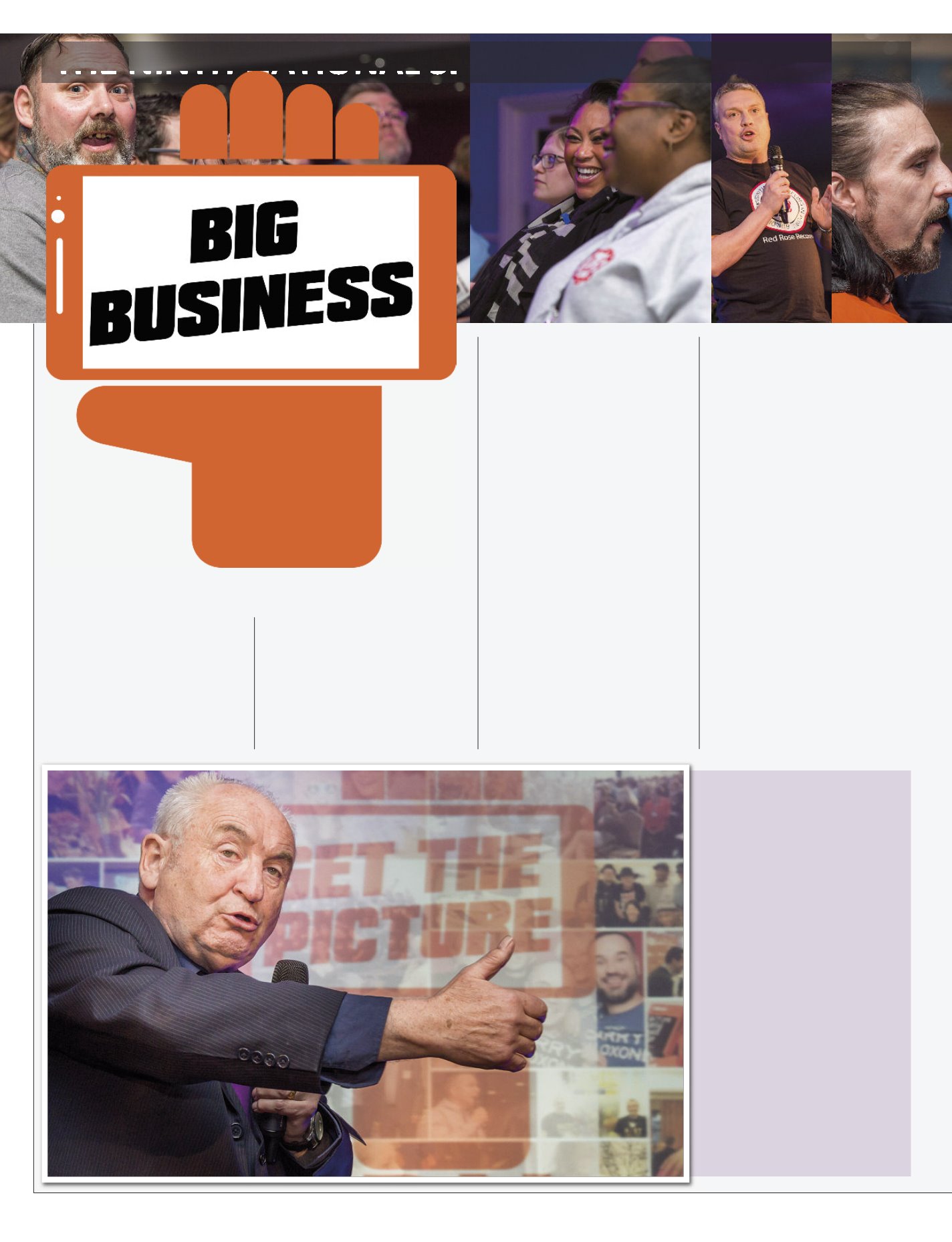
‘Don’t let anyone tell you that
you don’t have valuable skills,’
Big Issue
founder John Bird told
delegates in the day’s powerful
final session


