PALLIATIVE PROBLEMS
A NEW LOTTERY-
FUNDED STUDY
of end-of-life care
for people with
substance
problems has
been launched by
Manchester
Metropolitan
University and
partners
including
Aquarius and
Phoenix Futures.
‘Anecdotal evidence
suggests that
people with
substance problems
who are very unwell
avoid seeking the
health care they
need because of
their concerns
about how they will
be treated,’ said research lead Sarah Galvani.
‘It also suggests that professionals need some
support to know how to respond when people
with both issues do access services. This
research will start to explore these concerns.’
News
MARKET FORCES
ALTHOUGH MOST DRUG SALES
still take place
offline, the internet has the potential to
transform the drug market in the same way
that online shopping has ‘revolutionised the
retail experience’, according to a new EMCDDA
report.
The internet and drug markets
looks at
sales on both the ‘dark’ and ‘surface’ web, and
how they interact with traditional drug
markets.
Report at
DRY STATISTICS
SIXTEEN PER CENT OF BRITONS
attempted ‘Dry
January’ this year, according to Alcohol
Concern, with just over 70 per cent of them
succeeding in going the full 31 days without
alcohol. ‘People tell us that having a Dry
January has helped them to break bad
habits and to kick start a new
relationship with alcohol,’ said the
charity’s campaign director, Tom Smith.
NOT ON MY WATCH
PRESSURE GROUP STOPWATCH
has sent an
open letter to home secretary Theresa May
calling for police officers who repeatedly stop
and search people without grounds to be
subject to disciplinary proceedings. Although
nearly 60 per cent of searches are for drugs,
just 22 per cent of these actually find drugs,
the letter points out. ‘This suggests, at the
very least, professional incompetence,’ it says.
read the full stories, and more, online
PRISON STAFF
OVERWHELMED
BY NPS CRISIS
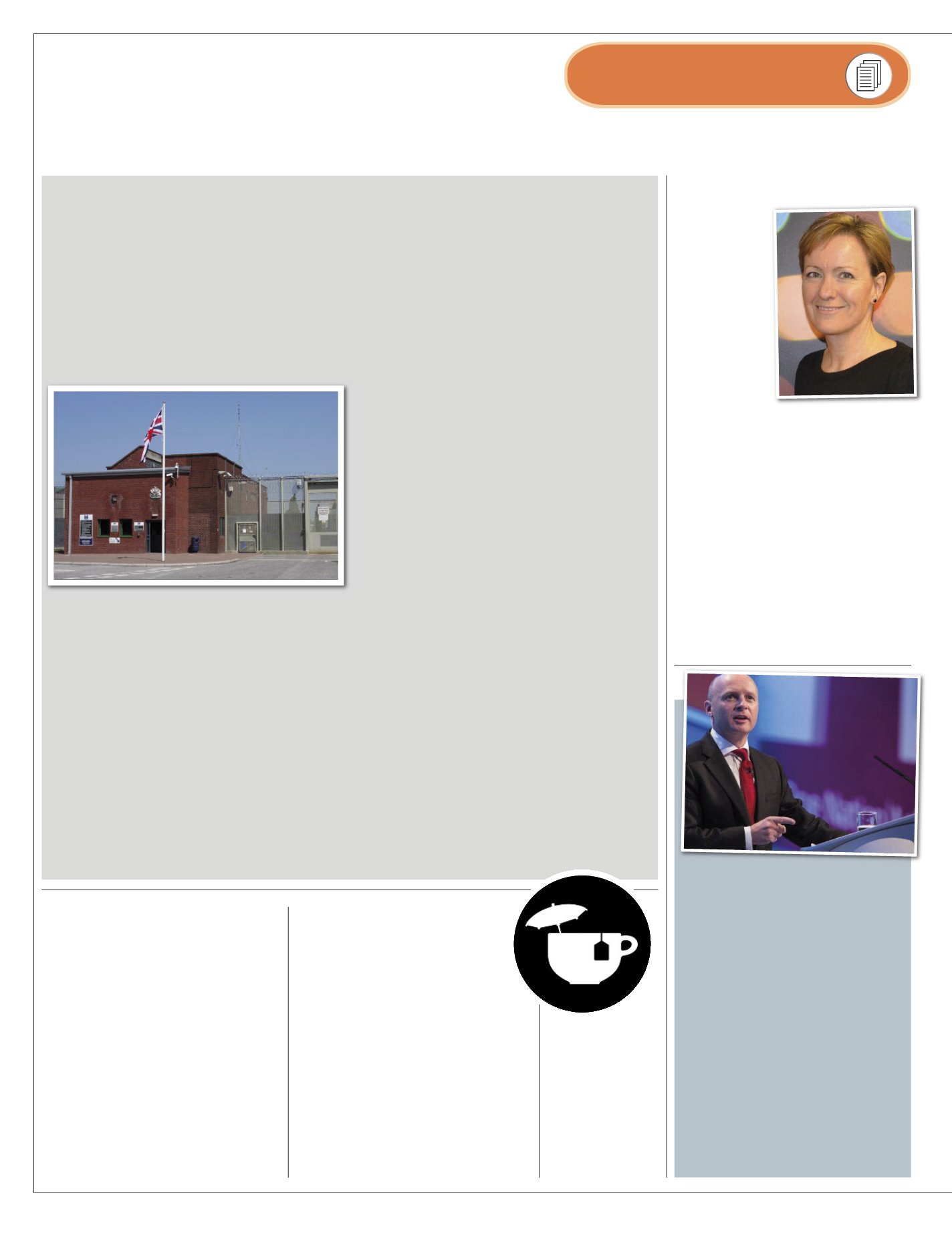
HEALTH STAFF AT A LARGE NOTTINGHAMSHIRE PRISON
risk being ‘overwhelmed’ by the demands of treating
people seriously affected by use of new psychoactive
substances (NPS), according to a report by HM
Inspectorate of Prisons.
Based on inspections carried out in August and
September last year, the report says that safety at the large
category C HMP Ranby is a ‘major concern’, with existing
problems exacerbated by a surge in the availability of NPS.
‘As we walked round the prison, we saw a number of
prisoners who were clearly under the influence of NPS;
some had been left with other prisoners to check they did
not deteriorate, because there were no available health
care services or other staff to do so,’ it states.
In addition to the health issues, the wide availability
of NPS was leading to serious problems around drug
debts and associated violence, says the report, with
almost 60 per cent of prisoners telling the inspectors
that drugs were ‘easy’ to get hold of in the prison.
Assaults on staff had increased significantly –
including ‘very serious’ incidents – and on one occasion
prisoners had forcibly entered an office to take back a
package of drugs intercepted by staff after it was thrown
over a wall. Self-harm levels were also higher than in
similar prisons, with four self-inflicted deaths since April
2015, while another death earlier this year was being
treated as murder. ‘NPS and the associated debt and
bullying had been cited as a significant factor in some of
these events,’ the document states.
Urgent action is needed to stabilise the prison and to
make it safer, urges the report, including an effective,
whole-prison strategy to reduce violence ‘and its
contributory causes’, although it does acknowledge that
the prison is ‘attempting to respond to these challenges’
and that there were signs of improvement in some areas.
NPS, particularly synthetic cannabinoids, are an area
of increasing concern for prison authorities, with the
recent HMP Inspectorate of Prisons
Changing patterns of
substance misuse in adult prisons
report labelling them
the ‘most serious’ threat to safety and security in British
jails, and calling for a national committee to address the
issue (
DDN,
February, page 4).
Meanwhile, new guidance on the prevention,
diagnosis and treatment of hepatitis C in prisons has
been issued by the Hepatitis C Trust. The document aims
to provide commissioners and staff with advice on
testing and treatment that can be used by ‘any prison
that needs to develop, revise or update their services’.
‘The prevalence of hepatitis C amongst people in
prison is so high that healthcare teams can’t address it
alone – it needs to be everybody’s business,’ says hepatitis
specialist nurse Jayne Dodd. ‘The governor, senior staff,
prison officers, healthcare team and substance misuse
staff all need to understand what hepatitis C is, the
transmission risks and the fact that it is curable. Through
training and education, we can end the stigma that too
often puts people off getting tested or treated.’
Report on an announced inspection of HMP Ranby by
HM chief inspector of prisons at
Guidance: hepatitis C prevention, diagnosis and
treatment in prisons in England at
‘Safety at the large
category C HMP Ranby is
a major concern.’
4 |
drinkanddrugsnews
| March 2016
SUPPORT
CALL
A BILL TO STRENGTHEN
SUPPORT
for the
children of people
with alcohol problems
has been published
Liam Byrne MP, chair
of the All Party
Parliamentary Group
on Children of
Alcoholics. The Children with Alcoholic
Parents (Support) Bill calls for a national
strategy and a dedicated minister, along
with far more transparency from local
authorities and health services around
budgets and the amount of support
provided.
See feature, next issue.
‘People tell us
that having a
Dry January
has helped
them to break
bad habits...’
ToM SMiTh
‘People with
substance
problems who
are very unwell
avoid seeking
the health care
they need.’
SArAh GALvAni
Liam Byrne
MP, chair of
the All Party
Parlia-
mentary
Group on
Children of
Alcoholics


