March 2016 |
drinkanddrugsnews
| 7
read the reports, see the pictures:
dependency, families, boundaries and
self-awareness, with all new members
invited to attend group sessions aimed at
challenging unhelpful ways of thinking.
‘Even if people don’t particularly care
about the harm they’re doing to
themselves, you can get them to look at
the harm they’re doing to their
community and their family,’ he said.
This was followed by a second phase
of support that shifted the emphasis
from drugs to improving self-awareness
and self-esteem and developing
emotional intelligence. ‘As an ex-crack
and heroin user, I know from personal
experience that the most important
step in life is the one you take when you
start to give back,’ he said, with the
third phase designed to give service
users the skills they needed to do that.
This included opportunities for
volunteering and working alongside
members of the community, with Bubic
gaining awarding centre status from
Gateway Qualifications in late 2014.
‘We like to make sure all our clients
feel included,’ said Oliver. ‘Everything’s
accessible, even for people who’ve been
disengaged from education for a long
time. It helps people to maintain their
motivation and their self-esteem.’
The organisation’s assertive outreach
work also enabled it to access any part of
the community, said Babalola, providing
information, guidance, support and
signposting to relevant services. ‘We walk
on the street, we go and meet people –
our own personal experiences have
allowed us to recognise the importance
of late-night outreach.’
Bubic also carried out inreach work
in prisons, he said, with a particular
focus on trying to ‘encourage emotional
intelligence and self-awareness’ prior to
release. ‘People get “gate happy” and
the risk is they’ll go and use,’ he said.
‘But it doesn’t have to be that way.’
T
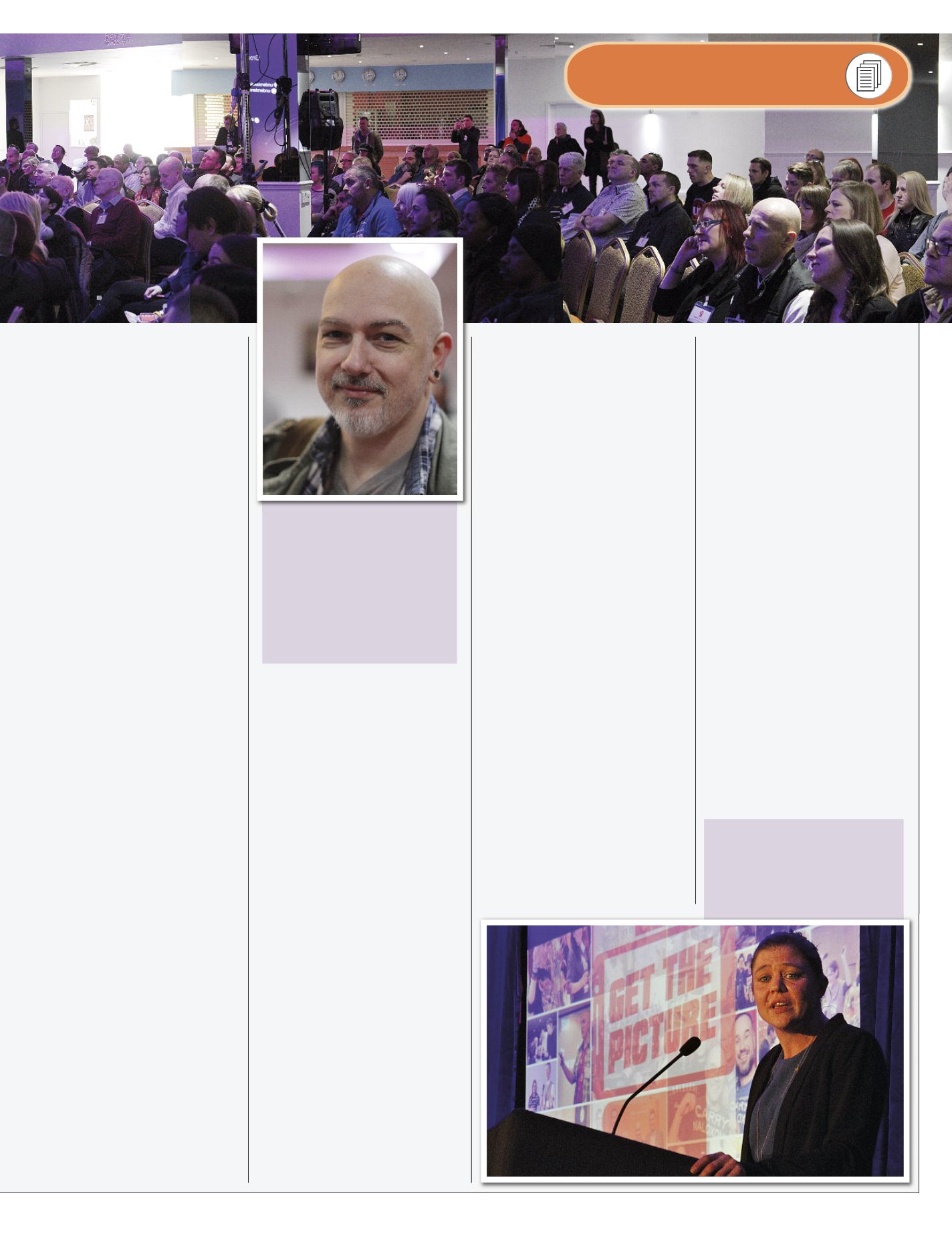
he next presentation was from
Nigel Brunsdon of Injecting
Advice, on the importance of
photography in helping to get a
message across. ‘We’ve got people
who’ve died,’ he said. ‘We’ve also got
our own heroes, people who are doing
great things. We can use photography
to highlight our achievements, celebrate
the big personalities in our community,
raise awareness of events and
important issues – like the availability of
naloxone – and promote change.
‘But it has to be us doing it,’ he
stressed. ‘No one is knocking down our
door wanting to take pictures of harm
reduction, recovery, anything. We have
to do it ourselves.’
The media, when it did use
photographs, wanted images of people
‘overdosing in doorways’, he said. ‘We
need to capture the narrative, and not
allow the media to dictate it. You don’t
need expensive equipment – everyone’s
got a mobile phone, so you’ve got a
camera on you all the time.’
Henri Cartier-Bresson had once said
that ‘your first 10,000 photographs are
your worst,’ he pointed out. ‘So keep
taking photographs, and share them.
Let’s make sure we’ve got a history for
the next generation that’s coming along.’
T
he session’s final presentation
was from three representatives
of the Anyone’s Child and
Recovering Justice campaigns,
Jane Slater, Fiona Gilbertson and
Suzanne Sharkey. The latter campaign
aimed to create a voice for policy
change, Gilbertson told the conference.
‘The war on drugs was never a war on
drugs. It was a war on people.’
When she had been a 16-year-old
heroin user in Edinburgh, the police
attitude had been to ‘criminalise us’
while the media attitude ‘was that we
should be left to die, or be put on
islands’, she said. There had been no
needle exchange facilities, and the
three pharmacists in the city that had
provided needles eventually stopped as
a result of police pressure.
Edinburgh’s reputation as an Aids
capital in the 1980s came about as a
‘direct result of bad policy’, she stated.
‘My partner died of Aids. I said to him,
“you don’t deserve this”. He said, “I’m a
junkie. I deserve everything I get.” That’s
what happens when you treat people
this way.
‘Our stories have power, and they’re
not often heard,’ she continued. ‘Never
underestimate the power of people to
change policy.’ Current policies were
inadequate and were killing people, she
said, and her organisation had been
working closely with Transform to show
the harms the war on drugs was
causing ‘to people like us and our
families’. The war on drugs was not a
‘fair fight’ and never had been, she said.
‘People like us all over the world are
caught up in this.’
‘I’m actually an ex-police officer,’
Suzanne Sharkey told the session. ‘I
joined the police in Newcastle and was
doing my bit, or so I thought – getting
drug users and dealers off the streets. I
thought that if we got you all off the
streets there’d be less drugs, less crime.
But I was naïve. I wasn’t helping the
community, I was harming it.’
Her own drug use eventually led to
her being arrested, she told delegates.
‘But it wasn’t the arrest that helped me,
it was the people I met in recovery. We
need to change policy, and we need
your experiences, your voice. Because
without reform people are going to
continue to be stigmatised and
marginalised.’
‘We’re wasting a hell of a lot of
money on a counter-productive and
futile policy,’ agreed Jane Slater of the
Anyone’s Child campaign. ‘I work for
Transform and we tend to produce a lot
of heavy, evidence-based texts. But
what we need to do is tell the human
stories.’
The campaign had been mounting
events and trying to get media
attention and engage with politicians,
she said. ‘We’re also going
international, because this is a global
issue. Prohibition is not the solution.
We urgently need a new approach.’
‘let’s make sure
we’ve got a history for
the next generation
that’s coming along.’
nigEl BrunSdon
‘What we need to do is
tell the human stories.’
JanE SlaTEr


