Historically, Gretna Green was the
destination for the romantic runaway
weddings of star-crossed lovers.
Nowadays, couples are stepping away
from tradition and seeking out the famous
Scottish town for intimate elopements
40 » pink weddings magazine
Running away togetheR
In 1754
, English lords introduced a strict set
of laws – Lord Hardwicke’s Marriage Act – that made
marriage a complicated business for some young couples
in England. A parental consent age of 21 was instated, and
all marriages had to take place in a church.
This left many young lovers without a means of getting
married in England – so their only recourse was to flee
across the border into Scotland to wed, where marriage
legislation was much more lenient.
The first stop on the main coaching route out of
England? A little town called Gretna Green, where couples
could tie the knot right there and then with just two
witnesses to the ceremony.
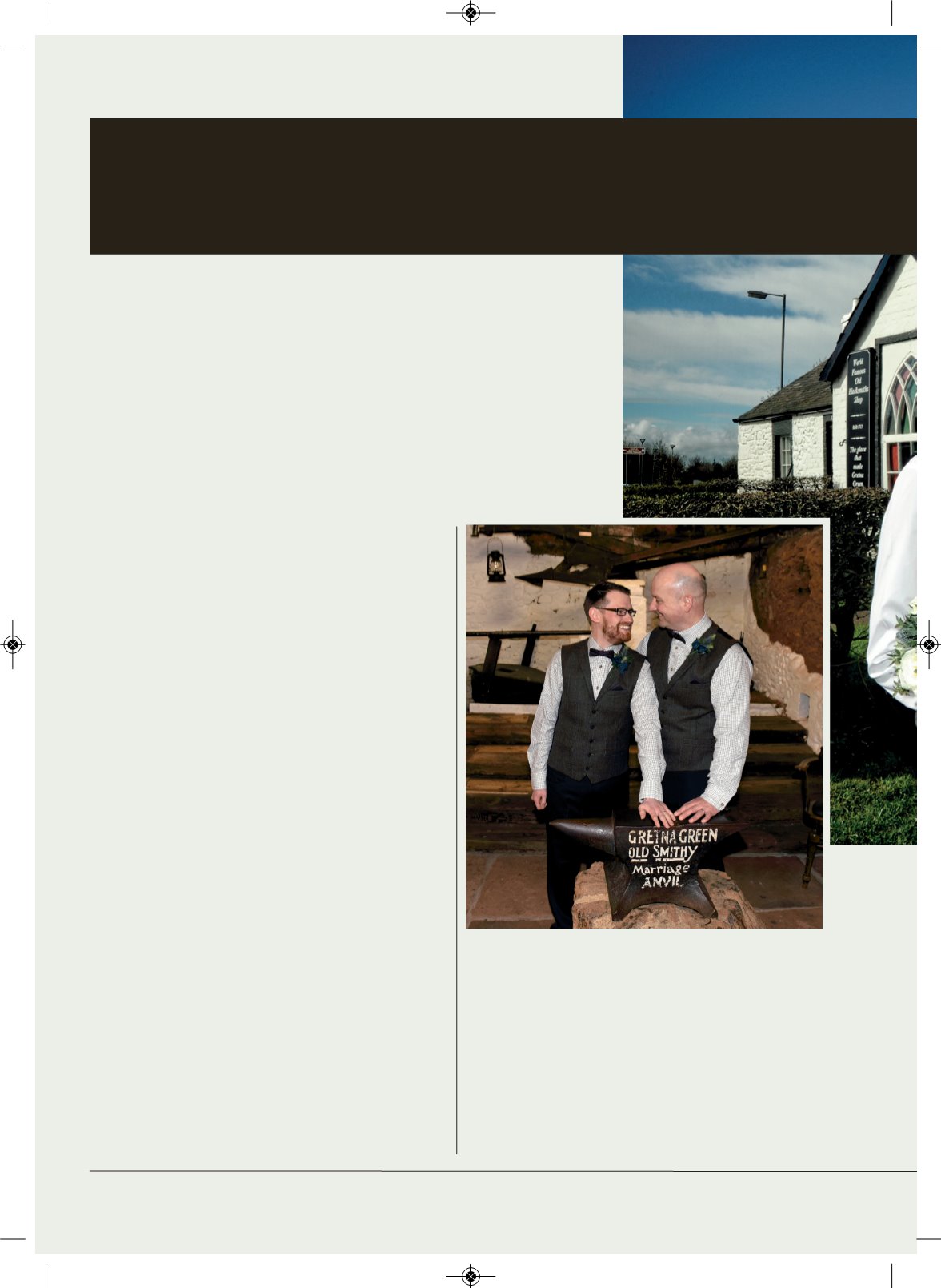
The now-famous Blacksmith’s Shop, the focal point of
the village, was the spot of many of these secret weddings
– which were performed by the blacksmith himself (the
‘anvil priest’) hammering his anvil to announce the happy
couple’s new status – a ‘marriage by declaration’. Tradition
had it that the blacksmith would join couples together in
the heat of the moment but bind them for eternity – just
like the metals he forged in his shop!
Predictably, scandal surrounding Gretna Green grew, as
more and more young couples broke social mores and fled
to marry those of different class and wealth. This has
given Gretna Green a reputation for romance and love,
with many modern couples taking the trip for a quirky
elopement or contemporary celebration with their nearest
and dearest.
In 1856, the Scottish Government brought in Lord
Brougham’s ‘Cooling off’ Act in an attempt to stop Gretna’s
‘over-the-anvil’ marriages. The new 21-day Scottish
residency law may have thrown the proverbial spanner in
the works for many couples, but some determined young
lovers managed to find a way around the law, often aided
by eager villagers.
Crossing the
Since 1886, The Blacksmith’s Shop has been owned by
the same family – who have been dedicated to retaining
both the tradition and character of the shop. Farmer Hugh
Mackie bought the building that year, restored it and
began promoting it as a wedding venue – meaning that
you can experience the same sense of romance today as
the eloping couples of yesteryear.
Although the ‘runaway’marriages by declaration were
outlawed in 1940, couples were able to resume making their
vows at the Blacksmith’s in the mid-1980s – and now the
historic locale hosts more than a thousand marriages and
civil partnerships every year, attracting couples, tourists and
p40-41 Gretna Green_Pink Weddings Magazine Autumn 2015 24/09/2015 11:50 Page 40


