sustainable revenue stream, Changes UK sees
volunteering as a means to an end. The value of
this was emphasised by Rosanna O’Connor, director
for alcohol, drugs and tobacco at PHE, who spoke of
the importance of volunteering in helping people
build confidence and shared how her own
experience of volunteering had put her on the path
to her career. Others to lend their support to the
new venture included Duran Duran bassist John
Taylor and singer Jimmy Somerville, who both sent
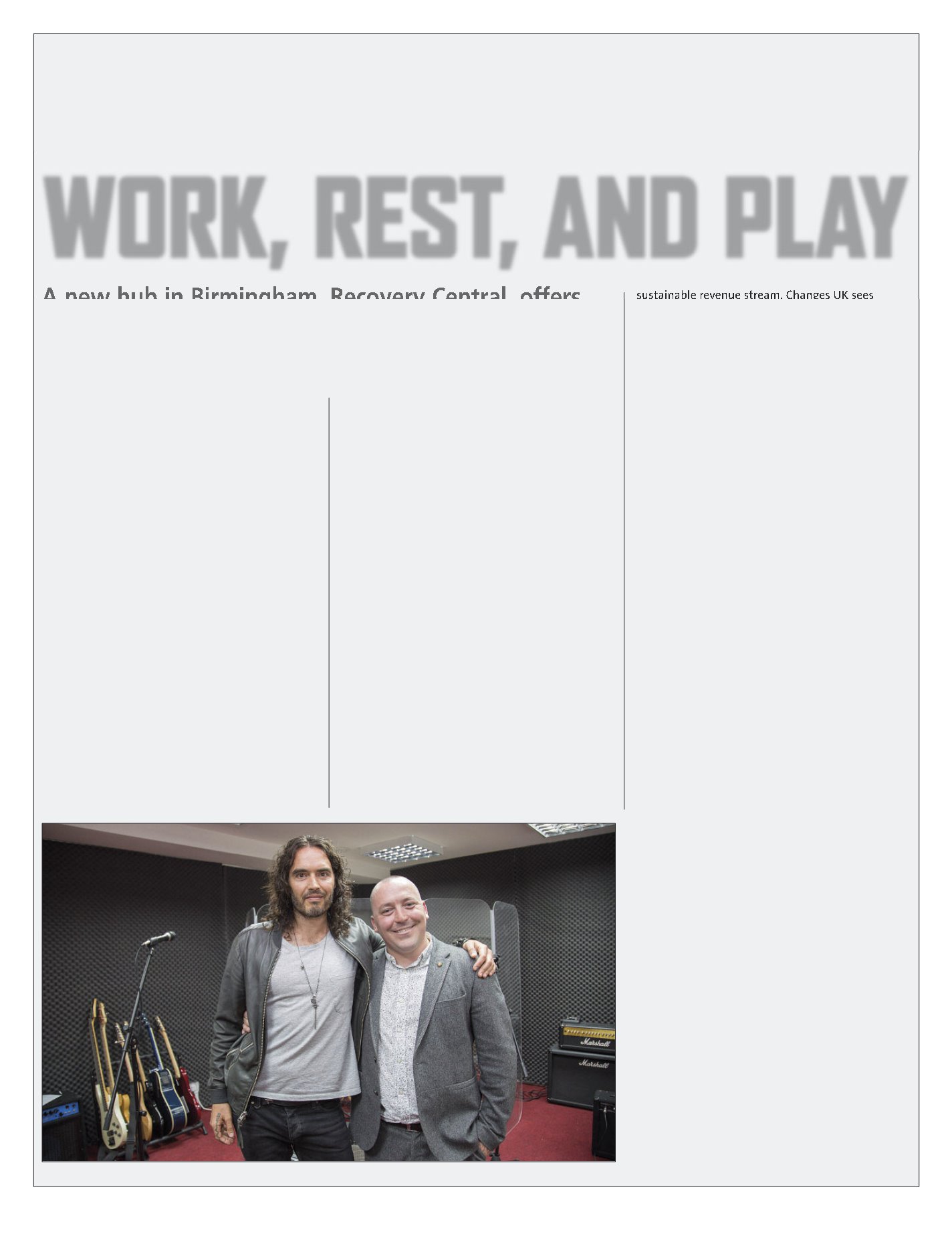
video messages. Actor Russell Brand attended the
launch of the centre to express his admiration for
the project and the way it supported individuals in
recovery: ‘This shouldn’t be a rare project, this
should be the standard,’ he said.
Members of the Changes UK team, Collette
Carter and Alex Davey, gave two of the most
memorable speeches of the day by explaining how
they had been able to transform their lives. Davey
relayed his experience of first meeting people in
recovery who were at peace with themselves, while
Carter said that she had been encouraged to go out
and find her passion. They both expressed hope
that Recovery Central would help to change
people’s perceptions of recovery, among both active
users and in the wider community.
‘The tanker is turning,’ added Dixon. ‘People are
starting to support recovery. Recovery Central gives
us an amazing venue that we can use to help more
people in our city into recovery from addiction and
gain the skills to live a life with meaning and
purpose, so that they also can be an asset to our
community rather than just a burden.’
Explore Recovery Central at
EntErprisE
Actor Russell Brand
attended the launch of
the centre to express his
admiration for the project
and the way it supported
individuals in recovery:
‘This shouldn’t be a rare
project, this should be
the standard,’ he said.
the reasons his attempts at recovery had been
unsuccessful had been because he had been on his
own. Returning to Birmingham, he realised he
wanted to help create a similar community in the
UK’s second city.
Using a house inherited from his grandmother,
Dixon started up Changes UK in 2007. It now
incorporates a detox service, community-based
rehab, supported and ‘move on’ housing, and it has
just opened the doors to its most ambitious project
to date.
Based in a former industrial unit in Digbeth near
the centre of Birmingham, Recovery Central’s 15,000
square foot venue provides meeting spaces and
office facilities to support the numerous projects
that will be run from there. One of new centre’s key
aims is to provide volunteering and training
opportunities to help people in recovery return to
work – particularly those who want to start
businesses or access training in different sectors,
beyond the substance misuse field. These ideas are
being put into practice, with the construction social
enterprise Building Changes providing volunteers to
work on the refit of the premises.
With an innovative business model that hopes
to help grow social enterprises to a point where
they will be independent and able to create a
ADDICTION CAN BE LIKE SWIMMING IN SHARK-
INFESTED WATERS
, but the recovery community are
like people in a life raft holding out their hands, Dr
Ed Day of the National Addiction Centre told guests
at the opening of Recovery Central in Birmingham.
Holding out their hands and welcoming people on
board was exactly what the team running the new
centre planned to do.
The new enterprise was planned and conceived
by Changes UK, an independent social enterprise
for people in recovery. It will provide support,
volunteering opportunities and business
incubation, and its facilities include a café, a dry
bar, and recording studios. It set up with Public
Health England (PHE) capital funding, working in
partnership with CGL, the agency responsible for
delivering services across Birmingham.
Changes UK chief executive Steve Dixon has
ambitious plans for the place. Described by Day as
‘the Richard Branson of recovery’ Dixon has always
been entrepreneurial, including spending every
hour working at his plumbing business to get
money for drugs. This finally changed in 2004 when
he met members of the recovery community in
Weston-super-Mare. Here he spoke to people who
hadn’t used for several years – an idea he said he
could barely contemplate – and realised that one of
A new hub in Birmingham, Recovery Central, offers
business incubation, training, support and more to the
city’s burgeoning recovery community. DDN reports
Work, rest, and play
16 |
drinkanddrugsnews
| June 2016
Russell Brand with Changes UK chief executive Steve Dixon


