June 2016 |
drinkanddrugsnews
| 15
MSc Public Health (Addictions)
The development of this new programme route in public health presents an
opportunity to share knowledge and develop skills in understanding and
addressing the impact of addictions on public health. This course represents
an opportunity to study the wider determinants of health, government policy
and examine the evidence base of harms and risks in relation to addictions
through epidemiological studies.
The MSc course is a modular-based programme, sharing a number of core
modules with students on the MSc Public Health and International Public
Health routes. Some modules are available as standalone or CPD’s which
allows you to build your portfolio of learning and credits to suit your
work/life balance.
Further information about the programme, including details about costs and
how to apply, can be found at:
Or you can discuss the content of the course in more detail by contacting the
programme leader:
Rose Khatri – Tel 0151 231 4118 – Email r.j.khatri@ljmu.ac.u
k
Use codeDDN10 for a 10%discount
Registered Company: 08085282
–––––––––––––––Tailored Training –––––––––––––––
๏
General Substance Misuse
๏
Alcohol Related
๏
Mental Health
๏
CPD, Leadership &Management
๏
Safeguarding
๏
Specialist Groups
–––––––––––––––––Consultancy –––––––––––––––––
๏
Service Auditing
๏
Clinical Assessments
๏
Medicolegal
๏
Reports
๏
Policy & Guidance
๏
Service Specifications
๏
Commissioning Support
๏
Conference & Event Speakers
–––––––––––––Clinical Management –––––––––––––
๏
Clinical Supervision
๏
Email Support
๏
Policy Writing
๏
Clinical Assessments
๏
Service Reviews
๏
Service Improvement & Development
Pulse Addictions is a leading provider of tailored training, consultancy and clinical
management to professionals throughout the UK. Designed and delivered by
expert practitioners in the field with a passion and proven track record for
enhancing treatment services in public, private & third sectors and NHS.
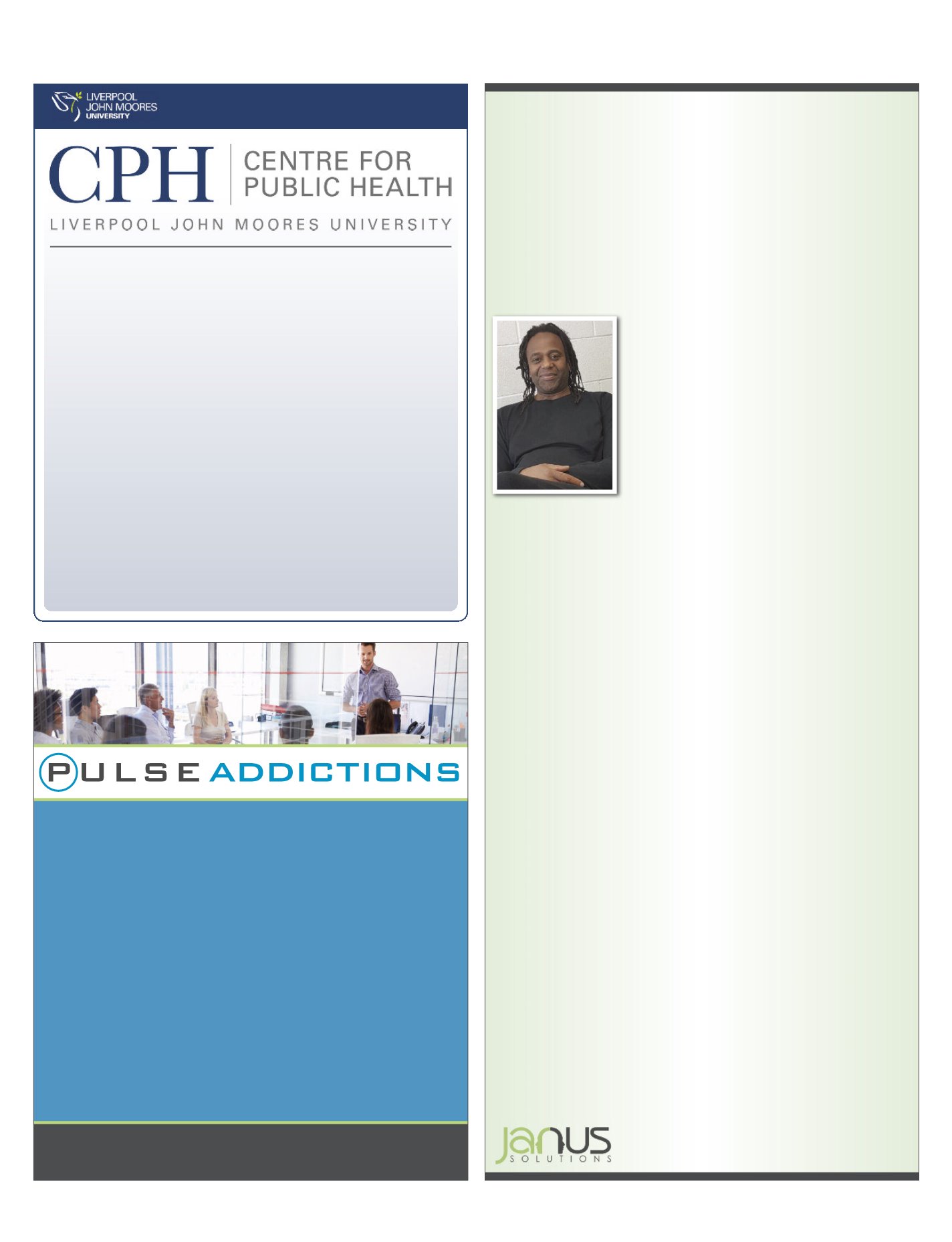
It’s time to stop relying on
outdated treatment models and
offer clients an approach they can
relate to, says
Kenneth Robinson
Promotional feature
An honest
relAtionship
O
ne of the most challenging things an individual,
group, or organisation can do is to look at itself
and how it operates. For the substance use field,
this means asking: how do you engage and work with
this client group?
The overarching response to substance use has always
been to use labels – addiction, dependent, sick, ill or
diseased – that appear to be supported by strong scientific
research. But have we stopped to think what messages
these labels are sending to the service user? Do they offer
a get-out clause, or a justification for them to continue
their relationship with a substance with total impunity?
As professionals we may not agree with the idea that the
client is sick, or that he or she is dependent on their
substance – or that they are unable to regulate their
behaviour and actions because they have no control.
Services may have inherited a way of working, validated
by many in the scientific community, that the substance
user is in some shape or form sick. We have also created
an even broader context called the bio, psycho, social
model, affirming that the client is affected by their
substance use at a biological, psychological and social
level. But could we be missing out the fundamental issue
of why they came to the service?
What if the service user is not sick, diseased, or addicted;
could this pave the way to look at their behaviour from a different angle? An example,
backed up by pharmacology, would be that drug use is very pleasurable and that is
why they keep returning. While being fed messages – that they are dependent, have
no control over what they do, have a sickness, and are simply a product of their
addiction – the client may always be able to justify carrying on using.
The Resonance Factor, the approach used by Janus Solutions – which we will
investigate further in two more articles in
DDN
– offers a counterpoint to the
established treatment approach in that it allows the client to own their love of
substance use. They explore their relationship with their substance and the
behaviours that they act out to maintain this relationship.
This process is then underpinned by deconstructing justifications for continuing their
use, taking them to a place of ownership and choice. Of course this is a challenging
process for the service user and, as with most forms of transformation, requires the
individual to go through a level of discomfort. But when our labels provide themwith
appropriate justifications for their past and future actions, we have to ask ourselves
– is this supporting the client, or are we becoming a part of their collusion?
While being
fed messages
– that they are
dependent...
and are simply
a product of
their addiction
– the client
may always
be able to
justify carrying
on using.


