problem.’ Unlike most of the soldiers, the drug use of addiction treatment
patients is entangled with social dislocation and multiple problems, which
unless addressed will repeatedly precipitate them back into addiction.
In Vietnam, soldiers from conventional backgrounds turned to
heroin to combat boredom and depression, pass the time, and to
better tolerate the rule-bound constraints of army life from which
there was no escape. According to psychologist Bruce Alexander, for
the same kind of reasons, caged experimental rats of the 1960s
compulsively pressed levers to get drugs in experiments thought to
prove these substances were inherently addictive.
Not so, argued Dr Alexander, demonstrating in his Rat Park study
that given a stimulating social and physical environment which
allowed the rats to be what rats naturally are – productive, active and
social – they consumed far less morphine. In this environment, even
physically dependent rats would avoid morphine.
From this perspective, treatment may be part of the solution, but
conceivably also part of the problem. Although those who later become
addicts often start with few personal, social and economic resources,
the little they do have will be eroded by criminalisation and social
stigma, and by services that explicitly or inadvertently encourage the
adoption of an addict identity – processes which further divorce patients
from supports which preclude dependent substance use or help us lever
ourselves out if it happens. The ladders are hauled up, blocking a return to
normality – a chronicity laid at the door of the addict’s supposedly chronic,
relapsing condition.
But accepting the identity of addict and patient gains access to the
micro-world of addiction treatment services, in which (at their best) the
addict is accepted and made the focus of caring attention and an optimistic
assessment of what they might become, moving them beyond an addict
identity rather than reinforcing it. The problem is that it is a micro
environment, and the effects typically erode on leaving.
Such thoughts pose practical dilemmas for treatment. If it takes on the
recovery challenge, how many fewer patients will we be able to afford to
treat, and will that be counterbalanced by slowing the revolving door of
relapse and treatment re-entry? Is it simply beyond the reach of any feasible
service to create environmental changes of the magnitude that led to rapid,
widespread and lasting remission from dependence among Vietnam returnees?
Must we set our sights lower and ameliorate the fallout from an addiction-
generating society, only modestly if at all accelerating the normal processes of
remission? Or would that be a self-fulfilling lack of ambition that fails to grasp
the recovery challenge?
The dilemmas were sharply put by Professor Neil McKeganey in his book,
Controversies in drugs policy and practice
. He asked whether a ‘revolution’ in
treatment was required, which might see dual tracks of intensive help for the
(perhaps relatively few) committed to recovery and abstinence, and a holding,
harm-reduction track for the remainder. Another way to square the recovery
ambition with numbers addicted and diminishing resources would, he argued,
be to refuse treatment or truncate it for those not committed to abstinence-
based recovery.
Though the solutions may be unpalatable, and abstinence an unnecessary
hurdle to the ‘recovery track’ or being considered ‘in recovery’, there seems no
denying that getting to recovery as typically defined requires more of treatment
services in the face of diminishing resources. Professor McKeganey reminds us
that decisions have to be made – or perhaps more realistically, not made quite
so explicitly, as we muddle through and make those decisions by default,
locality by locality.
This article is based on the Drug and Alcohol Findings Effectiveness Bank hot
topic, What is addiction treatment for? Full text with links to documentation at
.
Mike Ashton is editor of Drug and Alcohol Findings, findings.org.uk. Look out for
his new bi-monthly column in DDN.
June 2016 |
drinkanddrugsnews
| 13
Find more handy resources at
ACCESS TO DRUG TREATMENT SAVES LIVES
,
gives people a second chance, and reunites
families. This was the message from
Phoenix Futures, at the House of Lords to
launch the Griffiths Edwards Fund – to help
people to access residential treatment,
when they were unable to find funding
through other routes.
Former clients, several of whom now
work for the organisation, stepped forward
to talk about what the treatment had done
for them. ‘When I entered treatment I felt
helpless, but when I walked through the
doors at Phoenix I felt there was hope,’ said
Leanne. Ian told the story of how he had
moved from a life of crime to running a
successful business, putting back into the
system through paying taxes and creating
employment.
Another Ian and Stuart, both employed by
Phoenix, talked of the satisfaction they got
from working for the organisation and the
opportunity it gave them to give something
back, while former Addaction chief executive
Peter Martin spoke of how his incredible
journey had started at Phoenix.
Phoenix Futures supports many people
with complex needs around mental health,
housing, poor general health,
unemployment and debt. Speakers talked
about how they often benefited the most
from residential care, through respite from
day-to-day challenges and removal from an
often chaotic environment, allowing them
to focus fully on treatment. It also gave
providers the opportunity to build a support
package around them.
Last year Phoenix gave away more than half a million pounds worth of
residential rehabilitation and had risen to the challenge of providing these
services despite limited resources, said chief executive Karen Biggs. Much of this
work was with ‘people whose lives are not straight lines’, she said. But that fact
that 23 per cent of service users gained their first ever qualification while at
Phoenix demonstrated how they were helping people move on with their lives.
The new fund will provide access to residential treatment within the Phoenix
group, for those who are unable to access funding through other routes. As well
as providing support during treatment, the fund will enable people to engage
with housing, education and training opportunities to help them build a new life.
‘The fund isn’t named after Griffith Edwards purely because he was the
founder of Phoenix Futures,’ said Biggs. ‘It is because he was a humble self-
effacing man who believed that no one size fits all.’
To find out more or to donate, visit
edwards-fund
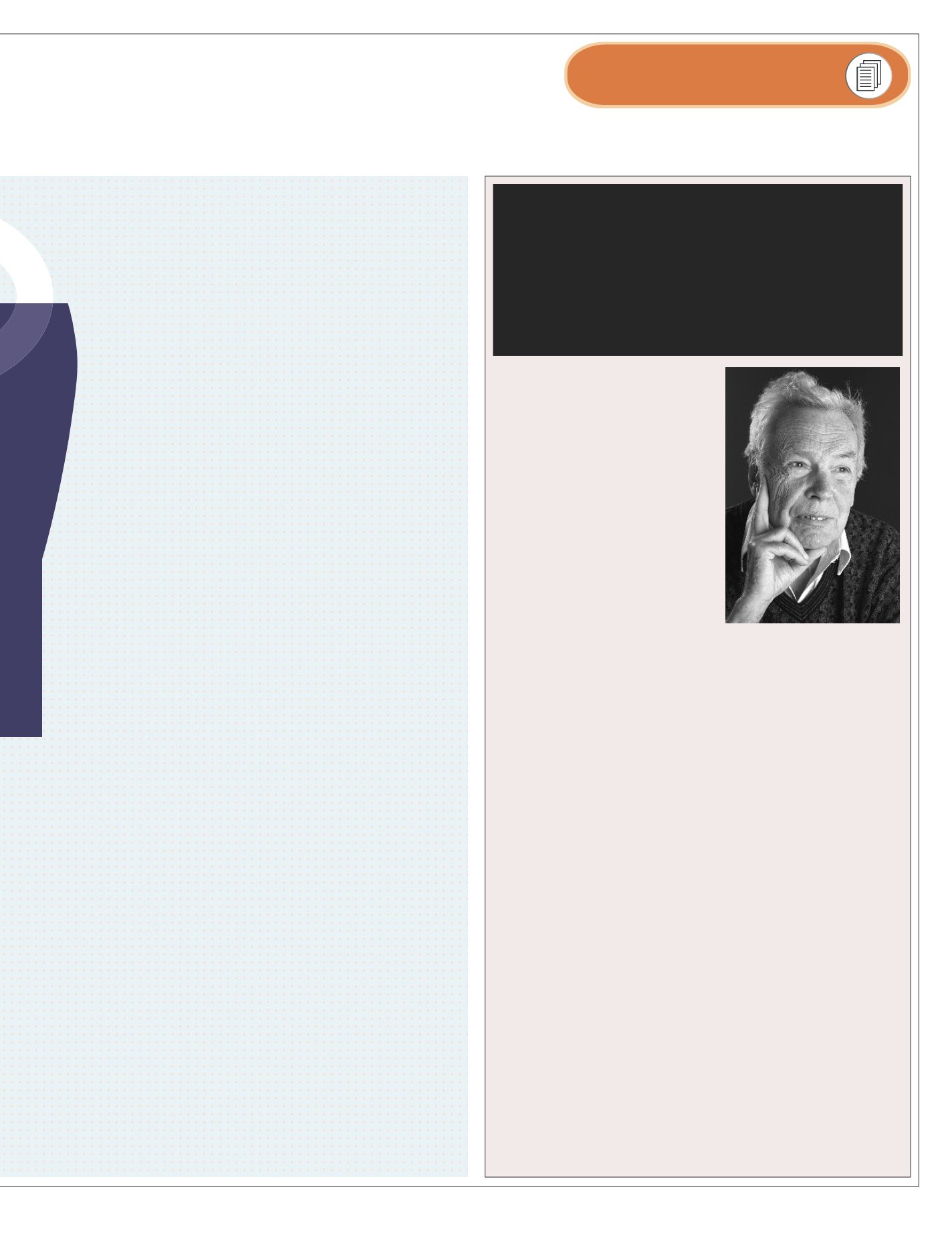
Griffith Edwards,
psychiatrist and
scientist, carried out
groundbreaking work on
treatment for addiction.
He was also founder of
Phoenix House more
than 45 years ago,
when drug and alcohol
‘treatment’ meant
being shut up for a long
spell in hospital.
A helping hAnd
Phoenix Futures has launched the
Griffiths Edwards Fund to champion
his belief that ‘no one size fits all’


