UK
governments agree that above all what they want out of
treatment is ‘recovery’. Some of the most marginal, damaged
and unconventional of people are to become variously
abstinent from illegal drugs and/or free of dependence and (as
Scotland’s strategy put it) ‘active and contributing member[s] of society’, an
ambition which echoes those of the UK government dating back to the mid-2000s
for more drug users to leave treatment, come off benefits, and get back to work.
Similarly, in 2008 experts
brought together by the UK
Drug Policy Commission agreed
that the process of recovery is
‘characterised by voluntarily-sustained
control over substance use which maximises health and
wellbeing and participation in the rights, roles and
responsibilities of society... a
satisfying and meaningful life’.
Potentially these agendas pose
treatment a daunting task – achieving a kind of
redemption in lives which among the caseloads of
publicly funded addiction services are often far from
satisfying and meaningful.
Shift ground from illegal drugs to tobacco. Would
you say someone who has stopped smoking but
hasn’t found a job, is still on benefits – maybe even
offending – and who remains at a loss for meaning in
life, has failed to recover from their addiction?
But perhaps there are good reasons why these
wider issues intrude for the more socially
unacceptable addictions. In the 1970s Lee Robins was
commissioned by the US government to help prepare
for the looming avalanche of addicts created by the
war in Vietnam, where heroin was accessible and
widely used by US soldiers. That avalanche never
materialised, and the returnees barely troubled US
treatment services. However, the few who did resort
to treatment exhibited the classic pattern of multiple
problems and post-treatment relapse.
Reflecting on the implications, Robins argued that
‘drug users who appear for treatment have special
problems that will not be solved by just getting them
off drugs... It is small wonder that our treatment
results have not been more impressive, when they
have focused so narrowly on only one part of the
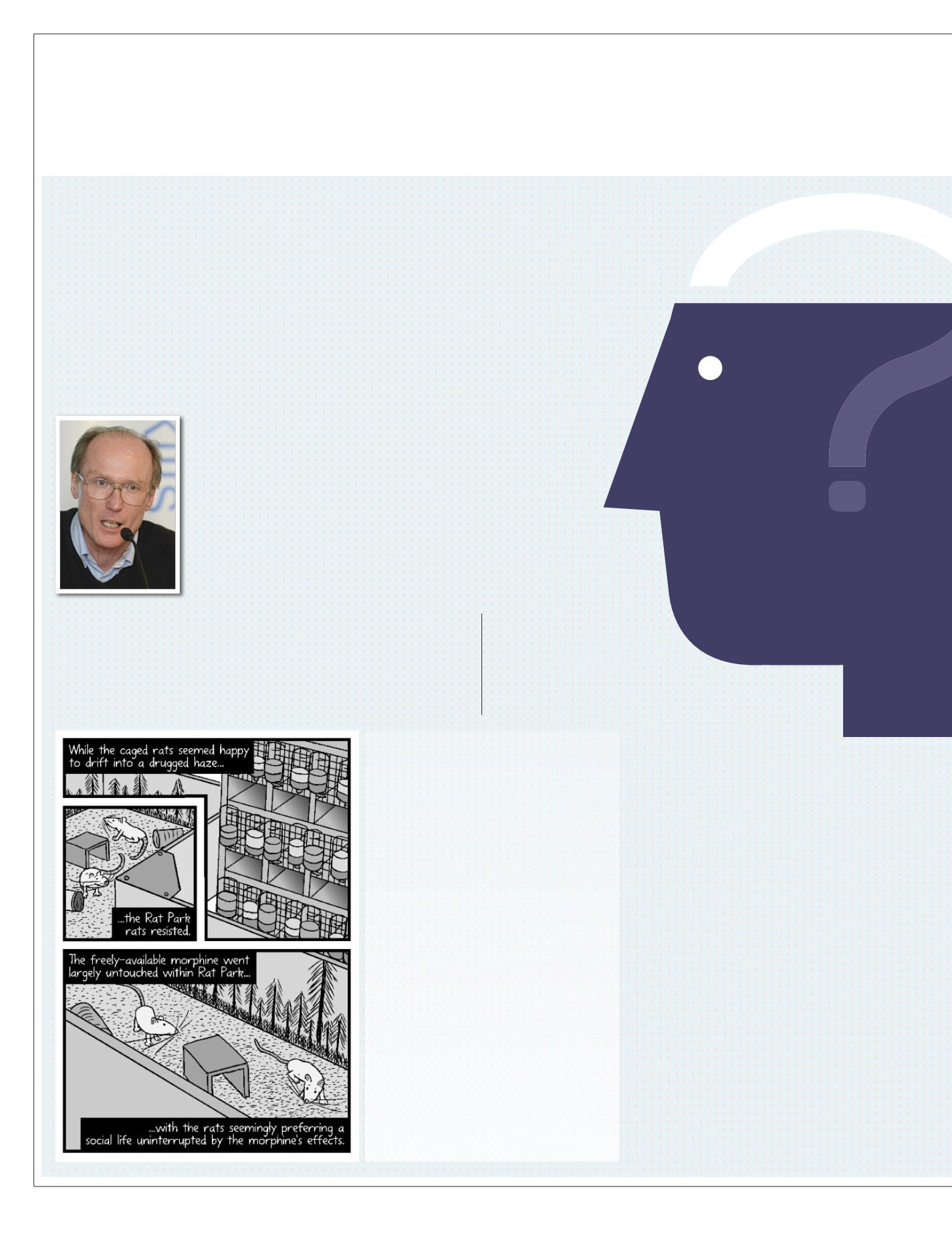
Dr Bruce Alexander demon-
strated in his Rat Park study
that, given a stimulating
social and physical
environment which allowed
the rats to be what rats
naturally are – productive,
active and social – they
consumed far less morphine
than a controlled, caged
population. Graphic by
Stuart McMillen from his
comic
Rat Park
– explaining
Bruce Alexander’s
experiments.
ratpark.com
ReseaRch
12 |
drinkanddrugsnews
| June 2016
Identity
crisis
What is addiction treatment
for – and has ‘recovery’
confused the agenda?
Mike Ashton
looks at the evidence


