
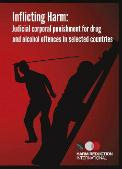
Thousands of people found in
possession of even small amounts of
drugs and alcohol are routinely caned,
flogged and whipped each year,
according to a new report from Harm
Reduction International (HRI).
More than 40 states enforce
judicially sanctioned corporal
punishment, says
Inflicting harm:
judicial corporal punishment for drug
and alcohol offences in selected
countries.
This state-sanctioned violence is in
clear violation of international law,
says the document, with UN human
rights monitors regularly voicing
concern. The vast majority of the
sentences are carried out in Malaysia,
Singapore, Iran and Saudi Arabia, says HRI, with judicial corporal punishment
also practised in Libya, Brunei, Yemen, Qatar, United Arab Emirates, Maldives,
the northern states of Nigeria and the Aceh province of Indonesia.
The legal basis for judicial corporal punishment varies from country to
country and can be provided for in either state or religious laws, says the
report, with some countries only using one type of corporal punishment – such
as caning in Singapore – while courts in countries like Saudi Arabia and Iran
might impose one of a range of methods depending on the offence.
The report calls for far more analysis of the long-term impact of the
practices as they leave ‘lifelong marks not only on people’s physical bodies,
but on their psychology’, said the report’s author and HRI human rights
activist, Eka Iakobishvili.
The practices were ‘cruel, inhumane and degrading’, said HRI’s executive
director, Rick Lines. ‘Effective drug policies are those that respect human rights,
international standards and scientific evidence of effectiveness. Corporal
punishment for drug and alcohol offences fails all three of these tests. It amounts
to little more that a government trying to brutalise its way out of a drug problem.’
Available at www.ihra.net
December 2011 |
drinkanddrugsnews
| 5
www.drinkanddrugsnews.com
News |
Round-up
Caning and flogging
rife for drug offences
Hospital admissions for drug-related
mental health and behavioural
problems have risen by 14 per cent in
a year, according to figures from the
NHS Information Centre (NHS IC).
There were 6,640 admissions in
England in 2010/11 compared to
5,809 in 2009/10.
Although the figures are still lower
than the 8,027 recorded a decade ago,
admissions where drug-related
mental health and behavioural
disorders were a primary
or
secondary
diagnosis have risen by 15 per cent in
the last year, to more than 51,000,
almost double the figure from ten
years ago. However, NHS IC stresses
this may partly be attributable to
changes in recording practice.
More than twice as many men are
admitted with a primary diagnosis of
a drug-related or behavioural disorder
as women, with the North West and
London strategic health authorities
(SHA) recording the highest rates of
primary diagnoses.
Statistics on drug
misuse: England 2011
draws together
previously published statistics with
unreported figures from NHS IC’s
‘hospital episodes statistics’.
Available at www.ic.nhs.uk
Sharp rise in
hospital
admissions for
drug-related
mental health
problems
KETAMINE CONCERNS
Three quarters of services questioned for
DrugScope’s 2011 street drug trends survey
reported an increase in people seeking help
for ketamine, says the charity. Evidence from
drug workers indicates that use of the drug
is far wider than the club and party scene,
said chief executive Martin Barnes, stressing
that services need to be sufficiently
resourced to respond. ‘People who use or
are tempted to use ketamine need to know
just how harmful this drug can be, and be
able to access timely and professional help
if required from their local drug services,’ he
said. www.drugscope.org.uk
CUSTODY COMMUNICATION
The Royal College of Psychiatrists (RCP) has
updated its guidance on the assessment
and treatment of people with substance
problems who are detained in police custody.
Substance misuse detainees in police
custody: guidelines for clinical management
has been revised by a working group chaired
by Professor Hamid Ghodse, and stresses
the importance of shared responsibility and
good communication, and that the ‘interests
of the detainee as a patient’ are paramount.
‘Addicted individuals should always be cared
for and treated without being stigmatised –
whatever their personal circumstances,’ said
Prof Ghodse. Available at www.rcpsych.ac.uk
PRE-LOAD PLEA
A campaign to warn young people of the
dangers of ‘pre-loading’ – heavy drinking at
home before a night out – has been launched
by Lancashire DAAT and the Safer Lancashire
Partnership. The campaign, which will run
throughout Christmas and includes adverts in
bars, on billboards and on Facebook, is in
response research by Lancaster University
which showed that 58 per cent of 18 to 35-
year-olds in the area indulged in the practice.
‘When people get extremely drunk early on in
the evening, their behaviour can create a real
headache for anyone left to pick up the pieces
such as the police, medical staff and fire
brigade,’ said Safer Lancashire Partnership
chair, David Smith.
PRISON PRESCRIBING
New guidance on prescribing medication in a
prison setting has been published by the
Royal College of General Practitioners’
(RCGP). The guidance covers issues like use
of benzodiazepines in treating anxiety
disorders, as well as questions of medication
misuse and trading between inmates. Safer
prescribing in prisons: guidance for clinicians
available at www.rcgp.org.uk
News in Brief
The number of people in Scotland who problematically use
opiates and/or benzodiazepines rose to nearly 60,000 in
2010, according to new figures released by Scottish NHS
body ISD (Information Services Division). This represents an
increase of more than 4,000 since 2006.
The age profile of users also appears to be getting older,
with 43 per cent of users aged 35 to 64, compared to 34 per
cent in 2006, while the prevalence rate in both the 15 to 24
and 25 to 34-year-old age groups has fallen. The highest
prevalence of problem drug use was estimated to be in the
Glasgow City Council and Dundee City Council areas.
While the figures showed that ‘Scotland’s long legacy
of problem drug misuse remains unacceptably high’ they
referred to a period when the Scottish drug strategy,
Road
to recovery
, ‘had only just been launched’, said community
safety minister Roseanna Cunningham. ‘Recovery from
drug addiction is possible and we will continue to drive
reform to ensure that recovery is accessible, visible and
sustainable,’ she said.
Poverty was ‘probably the single biggest’ contributory
factor to Scotland’s drug problem, said director of the Scottish
Drugs Forum (SDF), David Liddell, with the combination of
unemployment, lack of opportunity and continuing welfare
reform ‘hugely important factors for determining the future
levels of drug dependency’ in the country.
‘The figures show a very significant level of men aged
over 35 with a severe drug problem – research which SDF
has previously carried out shows that many are lonely,
isolated, experiencing major health problems and have lost
hope of ever having a better life in the future,’ he said. ‘We
need to provide education and training opportunities for a
larger proportion of this population than at present, and
also to look at supported employment programmes to
enable more people to recover.’
Estimating the prevalence of problem drug use in
Scotland 2009/10 available at www.isdscotland.org
Scots drug users getting older