Drug policy |
Russia
December 2011 |
drinkanddrugsnews
| 15
www.drinkanddrugsnews.com
‘Drug addicts are met with zero
tolerance in Russian society.
There are no proper therapies
and HIV-positive drug users or
those with TB can’t get proper
treatment, because doctors tell
them to stop using drugs first.’
The supply of syringes and antibiotics ran out quite fast, but more and more
people were coming. Some of them had wounds, some looked really ill. There was
a man who was hardly walking, with one of his hands swollen. The activists knew
him, but had nothing left to give him. I was really impressed when Alexander
Delphinov disappeared suddenly and returned with some extra supplies he bought
in the pharmacy – vitamins, ointment and bandages.
‘This guy was always so cheerful,’ he said. ‘Just a couple of weeks ago he was
going to quit using drugs and go to the hospital together with his girlfriend, who was
also a drug user. He was really worried about her, and we discussed the ways they
both could quit. But then she left him, and now he doesn't have the motivation to
quit anymore and increased his dose. Such things happen all the time – these
people are really ill and need help.’
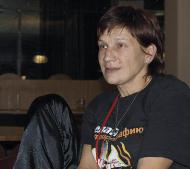
Irina Teplinskaya was the first drug user in Russia to speak out about her rights in
public. She is the face of Russian drug addicts, people without rights, without proper
therapy, repressed by the government and hated by society. As soon as she began to
talk openly about these problems in public, she began to be repressed. Just a while
ago, she was planted with a methadone tablet on her way from Ukraine to Russia.
‘They met me at the airport, eight people with a dog,’ she says. ‘They were really
shocked, when after searching me for three hours they couldn't find anything. The tablet
appeared out of nowhere – when they knew that they wouldn't be able to find anything
on me, they planted it. I am sure it was connected with my activism. It was an attempt
to bring down me and discredit my position, to get rid of me, because I began to sue
Russia in the European Court.’
When she advocates replacement therapy, she often talks about the Ukraine’s
drug programme as an example. Ukraine is a former Soviet Republic, which began
to apply replacement therapy 15 years ago, and now there are more than 6,000
people receiving treatment.
‘I think when Federal Security Service or the Federal Drug Control Service knew
that I was receiving therapy in the Ukraine, they assumed it was replacement
therapy,’ says Irina. ‘I think they were absolutely sure that I was bringing
replacement therapy drugs back with me. But they were wrong – it was three
months in a drugs-free zone, doing a different kind of therapy.’
Irina works for ARF and is a member of the steering committee from Russia in
Left: Irina Teplinskaya
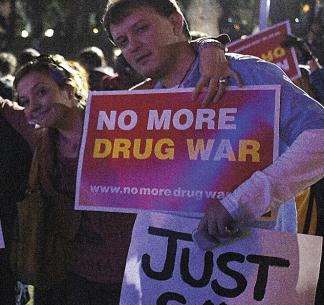
Far left: Russian
activists
the Eurasian Harm Reduction Network. Even though these two organisations are
well known around the world and widely supported, their work goes against Russian
drug policy.
‘In Russia, “those who are not with us are against us”, so it's rather normal that
drugs are used as a tool for political repression’, she says. ‘It’s a well-known practice
that drugs are planted on objectionable people who go against the political system.’
After the drug-planting incident, Irina decided to leave Kaliningrad, the city where
she lived, and move to the Republic of Tatarstan, a federal subject of Russia where
drug policy is better. There are government supported syringe and needle exchange
programmes, and the human rights of drug users are not violated as in Russia. ‘The
Tatarstan government understands that there is an epidemic of HIV, and it’s
impossible to stop it with only repressive measures,’ she says.
Irina is HIV-positive and had several breaks in her therapy when she was using
drugs. ‘Drug users who need to think about getting money for their next supply, and
then looking for a supplier, can’t concentrate on regular medication for HIV,’ she
says. ‘Doctors know that the drug user most likely won’t be self-disciplined enough
for HIV therapy, so they prescribe such therapy to this group of people quite
pessimistically and often find ways to refuse, because they see it as a waste of
money for the government.’
There are many problems with drug policy in Russia, and despite the activists’
work to try and change the situation, their impact locally does not seem to spread
to the country as a whole.
‘Society should change its attitude to drug users. It should not only be written
on paper that we are all citizens of this country and have our rights, but these rights
should be respected in practice,’ says Irina. ‘People should become more tolerant
to drug users. Russia should change its angle in drug policy from repressive to
humane, like it is in most other countries around the world.’ DDN
Kristina Kashtanova is a student journalist