
A recent discussion in the House of Lords coincided
with the announcement that unemployment levels
among 16 to 24-year-olds had overtaken the 1m
mark – a record high.
Chaired by Baroness Verma, the meeting was
organised by The Small Business Consultancy (
DDN
,
November, cover story) with the aim of generating
new ideas on tackling unemployment and barriers to
social mobility, through business and enterprise.
The panel was made up of Dr Hilary Emery, chief
executive of the National Children’s Bureau; Rajeeb
Dey, co-founder of StartUP Britain and CEO of
Enternships.com; Geoff Scammell, senior policy
advisor for the Department of Work and Pensions
RECOVERY
SMOKESCREEN?
Recovery is transforming the drug and
alcohol treatment landscape to the
extent that it is possible to use the term
as a smokescreen to mask the complex-
ity of the problems still associated with
the development of people who embrace
the recovery door with so much hope for
a better future. A significant paradigm
shift is taking place within the world of
commissioning – the most profound
difference is that we have come to
believe that recovery is the white knight
that comes to the rescue.
I have no doubt that it is a contri-
butory liberating factor unlocking the
potential people have to escape from
obsessive-compulsive behaviours and
lost opportunities. Yet it is easy to
confuse the first stages of recovery with
the genuine sustainability factor needed
for social mobility. There is no doubt that
the peer dynamic concept can help
people manoeuvre from the cul-de-sac of
despair on to the road of transform-
ational change and, yes, the group
dynamic programme can alter and
expand the limiting mindset of irrational
beliefs and behaviours by embracing the
incremental process of a new beginning.
The scientific evidence measuring
long-term social mobility success of
recovery programmes is still weak,
inconsistent and almost nonexistent
within credible research journals,
especially in the measurement of the
sustainability factor with prolific
offenders embracing social mobility
five years after the drug and alcohol
recovery programmes have ended. This
is most notable with individuals who
have low self-esteem and turbulent
backgrounds of institutionalism. The
best we can hope for is weak
methodology from American culture
radically different from our own, with
an insufficient critique of research
findings. This is not helped by the fact
that there is still not a unifying
scientific theory of recovery.
As someone who has led a recovery
community for over ten years with an
empirical evidence base of cultivating a
culture of recovery leaders with the five-
year sustainability factor of successful
social mobility, nurtured from the prison
gate and now climbing a professional
ladder of success, I feel proud in what
we have achieved. However, I also see
the many faces of people accessing our
drop-in-centre each day who represent
the chronically excluded, lost in a world
of inner turmoil, devastation and
confusion. Recovery is an alien
environment for many of these people.
Commissioning can be hampered by
cognitive limits when dealing with
complexity – complex individuals are a
heavy burden on criminal justice and
healthcare budgets. They remind us that
one size does not fit all. Equally some
of those who have completed recovery
programmes can still be entangled with
complexity.
A recovery culture is a complex
environment because it can be hard to
predict what will happen. We need to
differentiate a recovery programme
from a recovery culture. A recovery
programme is clearly defined – it is
time bound with clear goals, rules and
expectations. A recovery culture is
Letters |
Enterprise report
LETTERS
10 |
drinkanddrugsnews
| December 2011
www.drinkanddrugsnews.com
Hitting the right high
With the right support, disadvantaged young people could be part of the answer to Britain’s debt
crisis, concluded a gathering of entrepreneurs and politicians.
DDN
reports
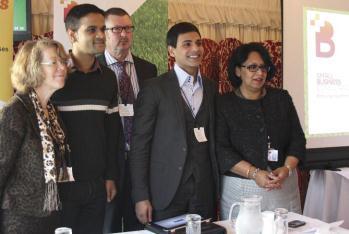
The enterprise panel, (l-r): Dr Hilary Emery, Rajeeb
Dey, Geoff Scammell, Amar Lodhia and chair,
Baroness Verma. The parliamentary discussion was
held on Social Enterprise Day.