

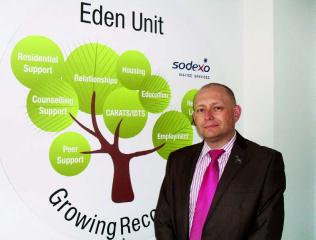


prisoners remain focused while on the wing – graduates are provided with
training and support to deliver in-house mutual aid interventions to complement
the core service.
*****
A common issue raised by graduates who achieve abstinence is that on release they
are often referred to community treatment systems which, by design, seek to
deliver prescribed interventions. Forest Bank is committed to working with
community partners to ensure that the drug-free success achieved by prisoners
continues on release, as continuity of care is vitally important. In fact, the prison has
been approached by external organisations on behalf of individuals at other prisons
who are seeking to transfer to Forest Bank specifically to get help from the unit.
A particularly exciting project now under development is our employment-
focused social enterprise, which will allow prisoners to learn specific skills and
experience through an NVQ-accredited training programme. The social enterprise
element will secure relevant commercial contracts in the community and offer
prisoners the opportunity of real paid employment on release, with potential jobs
including facilities management services like grounds maintenance and catering.
Forest Bank prisoner Barry is serving his sixth sentence and is currently based
in DFW. ‘After being on the Eden recovery pathway, I’ve learned to lead a life
without drugs,’ he says. ‘I have all negative MDTs [mandatory drug tests] and
VDTs [voluntary drug tests]. I’m now acting as peer support on the wing as a
mentor. I deliver group work sessions once a week to up to 12 other prisoners.
I’m just hoping I can carry it on when I get out. I’m reducing at the moment, and
hopefully by the time I get out I’ll be completely drug free.’
Recent independent inspections by the Ministry of Justice and the National
Offender Management Service (NOMS) commended Forest Bank on the excellent
quality of its substance misuse interventions, with one citing the prison as ‘a
model of excellent service delivery which others should follow’.
*****
Ultimately, what Forest Bank wants to achieve is the following scenario:
A prisoner arrives with a serious and sustained offending-related substance
misuse problem. During his sentence, he begins his personal recovery journey. He
achieves complete and sustained abstinence and receives employment-related
training. On release he is offered suitable accommodation at a project where he
receives ongoing support to maintain his recovery, and the social enterprise offers
him paid employment, which allows him to use his new skills and gain valuable
work experience, leading to a permanent full time job, no reoffending, and
successful reintegration back into society.
Ian Houghton is head of commercial development at HMP Forest Bank
August 2012 |
drinkanddrugsnews
| 17
www.drinkanddrugsnews.com
Treatment|
Enterprise corner
ENTERPRISE CORNER
‘A YEAR ON...’
The social media and messaging between
young people involved in the riots last
year showed that they need never be
hard to reach, says Amar Lodhia
This time last year
, our country was coming
to terms with the UK riots. Young adults
conformed to commit acts of theft and
vandalism, which were brokered through
technology and social media, namely
BlackBerry Messenger. The riots brought home
that in fact ‘hard-to-reach’ young people
aren’t hard to reach. So how can innovation
and technology reach, inspire and support
young people to progress and abstain from
reoffending through a means and a language they know very well?
In March I got to thinking howwe could possibly begin to answer this.
It is a sad fact that young people growing up in these troubled times
have lost their access points with over a third of Connexions services
now closed. This has a major impact on the work that youth offending
teams do with post-16 young offenders. More than this, it came to light
in the debate around the multiplier effects and combined costs that all
the wraparound services that go into dealing with troubled families
amount to over £200,000 per family per year.
Part of the answer for us was in finding a way to empower and enable
young people to interact with media technology they know in a positive
and enterprising way. We’re currently developing Enterprise = Apps²
(E=A²) a groundbreaking programme that will allow participating young
people to build a smartphone app and launch it on the various app
stores. The platform is being developed in partnership with an Aberdeen-
based tech entrepreneur, Andrew Sage.
I was personally shocked that when I logged into the Research in
Motion website (manufacturers of the BlackBerry) and typed in ‘riots’ in
the search bar, nothing came up. One of the main recommendations to
businesses made by the Riots Panel, chaired by Darra Singh in March
2012, was that brands that young people interact with should show
more corporate social responsibility and that government should do
more to encourage responsible capitalism. So on the back of this I will be
personally approaching Research in Motion, manufacturers of the
BlackBerry, as well as Google UK, Apple and Facebook, to support E=A².
I’d love to hear your views. Email me personally at ceo@tsbccic.org.uk
and follow us on Twitter @TSBCLondon. Tweet your comments using the
#tag DDNews.
Amar Lodhia is chief executive of The Small Business Consultancy (TSBC)